"Adventure: the pursuit of life." - Daniel Roy Wiarda

"Adventure: the pursuit of life."

-Daniel Roy Wiarda

Sunday, October 24, 2010

Adventures and Absurdities (and alliteration)

I really don't feel like doing work right now, so I'll blog instead. I was going to remark on how quiet this week has been, but then I remembered that I would be lying. It's been an interesting week! It all started with Monday, which was the most absurd day of my life. Stephenie and I decided to head down to Ipswich, which is the capital of Suffolk. It is not as cool as Norwich. Bottom line: when Lonely Planet tells you that a town is not worth a detour, listen! We made it to Ipswich without a problem, but we quickly realized that we were the only two Americans in the entire city, and later we extended this to include the entire county. We were super subtle and had a book of city walks in East Anglia, and we got a lot of strange looks. I mean a lot. We stopped counting around 35, and we'd only been there for two hours. That was enough time to realize that Ipswich is actually really boring and completely depressed (maybe because it was so dependent on the docks that are no longer used? Norwich has been able to develop a pretty good tourist trade to make up for its loss of industry; Ipswich not so much), and we got bored of walking around.
So we decided to move on to Sutton Hoo, which we thought was just a short bus ride away. We were sitting there at the bus stop, waiting for the 71 bus, when what I can only describe as an Australian bush van came careening to a halt in front of us. I didn't even realize that it was a legitimate bus until I saw the numbers on the back - 71. I just burst out laughing so hard that I started crying, boarded the bus with tears streaming down my face, and then held on for dear life because I thought that I was going to die. It was ridiculous. Steph and I were keeping an eager eye out for Sutton Hoo, and as we flew past it I pressed the stop button. Now, on most buses the driver waits for the next legitimate stop and then lets you off the bus. Not the 71 - the driver screeched to a halt and left us on the side of the road, so we had to wade through waist-high grass to get to Sutton Hoo. Oh dear. Then we had to take silly pictures by the sign, of course, so all of the motorists stared at us. We were those tourists.
We finally made it to the actual site of Sutton Hoo (had to walk by a farm first), which was interesting even though there wasn't a whole lot to see. Archeologists still don't really know why Sutton Hoo was used as a burial ground, because there wasn't a settlement on the site. But it was clearly a very honored burial ground for either the Angles or the Saxons (archeologists aren't sure about this either, although the text at Sutton Hoo buys into the idea that it was Anglian. The scholarly debate is between two kings - the Anglian king Raedwald and the Saxon king Sigehberht, whom I refer to as Redwall and Sherbert, respectively). Because East Anglia changed leadership between the Angles and the Saxons so many times, it's difficult to determine who was in power at the time that Sutton Hoo was created. Regardless, it dates from the seventh century, right around the time that Christianity was spreading throughout England. Sutton Hoo is famous because it contains two huge ship burials, one of which still contained a vast treasure, including the Sutton Hoo helmet now on display in the British Museum. This find was monumental because it demonstrated that the early East Anglians were much more sophisticated than archeologists believed, namely because of the influence of other cultures on the burials. Coins from Merovingian France were found in the burial, and the very idea of the ship burial came from Danish culture, so there must have been trade between those two regions and East Anglia (no similar burials have been found elsewhere in the country). The find also legitimized Beowulf as a sort of anthropoligical record of Anglo-Saxon culture. Today you can see the burial mounds, which have been reconstructed following extensive excavations in the late 1930s. Not much to look at, I'm afraid, but the historical significance is huge.

Following our adventures at Sutton Hoo, Steph and I got back on the bushwhacker van to return to the center of Woodbridge and catch another bus back to Ipswich. Well, we got on the right number, but it was going the wrong way. We only realized this after we got out of the city and saw a lot of fields, so I swallowed my pride and my panic and went up to the busdriver. The conversation went kind of like this:
me: "So, we were trying to get back to Ipswich, and we obviously got on the wrong bus. What do we do?"
busdriver: *blinks*...silence... "You wanted to go to Ipswich?" *bursts into laughter*
I was not encouraged, espcially when he pulled the bus over because he was laughing so hard. True story. It turns out, however, that he was very nice and that he got me to find the humour in the situation. His was the last bus of the day, so even if we'd gotten off to wait for the bus going the other way, it would just be him on his way back to Ipswich (finally), so he told us to just stay on the bus and keep warm. To make a long story short, we made it all the way to the North Sea, saw quite a bit of scenic Suffolk countryside, and then saw it all again! During our 3.5 hour adventure on the bus I got a lot of reading done for class, and the driver would frequently glance into his rearview mirror and say something witty such as, "Any of this look familiar?" or, "So you were 40 minutes away from Ipswich, but now you're an hour and 40 minutes away!" and my personal favourite, "Oh, I can't believe you did that - you made my day!" He seemed to take quite a liking to our misadventure, so he actually dropped us off right in front of the station, a special trip, with a warning to us to get on the correct train. Oh, wonderful busdriver, I am forever indebted to you!
I never thought that I would be so happy to see Norwich as I was after that trip. Steph and I treated ourselves to a wonderful Italian dinner at a restaurant in city centre, including an enormous ice cream sundae drenched in amaretto. Completely necessary. I didn't make it back to my flat until 11:30, when I did some reading and then fell into bed, only to be woken an hour later by screaming outside. Normally I can sleep through such outbursts, but this time someone was screaming my name. It took a few miinutes for my groggy brain to comprehend that Amy was under my window yelling for me, and that it was Alessio yelling, "She's ignoring you!" before breaking into Lady Gaga. There was no going back to sleep after that, especially when Alessio proceeded to run up and down the hallway shrieking, "Fire hazard! Fire hazard!" while throwing toilet paper everywhere. Oh flatmates, I love you.
On Tuesday I decided to get lost more locally, so I took my Norwich A to Z (pronounced zed here) and a walking route that I had gotten from the city website and wandered downtown Norwich. It was much more successful than the previous day's adventures!
The rest of the week was pretty quiet. Four of my flatmates went home for the weekend, and it was on the cold and rainy side. On Saturday morning we had our last walking tour as a giant, obnoxious group of 27 Dickinson humanities students. Professor Qualls assigned each of us a site in Norwich, so we had a lovely four-hour tour in the raw, wet weather. Huzzah! But I do love the city, and we did see some cool spots, including a street that was used in the movie Stardust. After our epic tour we all went back to Professor Qualls's house to have a wonderful lunch, and I ended up playing Apples to Apples with his son. It was an excellent way to spend a rainy Saturday afternoon!
So whereas it's been relatively quiet for me, it has been a fairly dramatic week in European politics. The coalition government in the UK announced huge budget cuts this week, combined with higher tuition fees and a rise in the pension age. As with all budget cuts, there's a lot of debate over who the cuts will affect the most. There haven't been the outward reactions in Britain that there have been in France (BBC News had an interesting editorial on the French strikes and the American way - ) because the Brits don't really seem to get riled up by much. They grumble and then carry on, although Nick Clegg, the Lib-Dem deputy prime minister, has spoken out over unlimited increases in tuition fees and welfare cuts, both of which are part of the budget cuts. What I don't understand is the inefficient way that the wellfare state is set up - it's not dependent on economics. As far as I can muddle it out, all families, no matter how wealthy they are, get money from the government for their children. Similarly, all people over a certain age receive a larger heating allowance than younger groups. This sounds nice, but it means that millionaires are receiving government support when they are perfectly capable of paying for their own heating. This makes no sense to me - I feel that it would make more sense to base services on income. I don't claim to have anywhere near a perfect understanding of the situation, however. We'll see what happens.
November has turned into travel month, so I should have many exciting adventures to report to you soon! And Happy Halloween!

Sunday, October 17, 2010

"I'm Very Fond of Walking": Finding My Inner Elizabeth Bennet

We've been on two treks into the greater Norfolk area since the last time that I blogged, AND I've learned a lot more about the history of said area! Huzzah! I'll just orient you a bit: this area has been settled at least since the Bronze Age. During the Iron Age (ca. 800 B.C. to A.D. 43) it was inhabited by the Iceni tribe. When the Romans took over Britain in A.D. 43 (See? You knew that from my earlier blogs!), they pillaged Iceni lands, killed the Iceni chief, and tortured his queen and raped his daughters, so said queen, Boudicca, led an attack on Colchester and London. She was eventually executed, but not before kicking some serious ass. This tangent is brought to you by the letter B and the fact that archeologists think that the Iceni headquarters may have been where Norwich Castle is now.
Anyway, there was never actually a Roman settlement in Norwich, although there were people here. Then in 870 the Danes conquered East Anglia, but in 917 they were defeated by Edward the Elder (good title) and the area passed into West Saxon hands. Norfolk comes from the Saxon term meaning "North Folk" (ergo Suffolk = "South Folk"). Norwich began to grow as a city out of several smaller Saxon settlements, and it was becoming increasingly important for trade with the Low Countries. Norwich is kind of like Hartford - it was the farthest point inland that ships from the North Sea could sail, therefore it was a thriving hub of a place. The Danes, who were angry at losing East Anglia, conducted lots and lots of raids during this time, and their influence can be seen in the ship-burial at Sutton Hoo (where I'm going tomorrow!). They got their revenge in 1013 when the Danish king Sweyn conquered England from the Saxons, but he died immediately afterward. Sucks for him. His son Cnut took over, though, and England was under Danish rule until 1066 when the Normans came, invaded, and built lots of castles and churches, many of which are in Norwich! Norwich was actually really important during Norman and medieval times, and was the largest city in England after London. It was famous for its agriculture (lots and lots of rich wetlands) and its sheep, hence there was a thriving wool trade with the Low Countries. Eventually a number of Dutch weavers moved here, and Norwich became famous for textiles, a position that it held until textile production was mechanized and moved out of East Anglia during the Industrial Revolution. There are still a lot of sheep here, though. So there you are, your mini Norwich history lesson.
Besides reading about Norwich until my contacts fell out (you think I'm kidding - I'm not), I've also been frolicking about the countryside. And by frolicking I mean walking at a fairly leisurely pace, stopping to smell the proverbial roses frequently. Last weekend the Dickinson humanities group, under the fearless (and sometimes wayward) leadership of Karl Qualls, took a train to Sheringham, an adorable little town full to the brim with chocolate shops. It was once a popular Victorian beachside destination, although I can't really imagine the Victorians letting their hair down and frolicking in the waves, especially in the North Sea. That water is COLD!
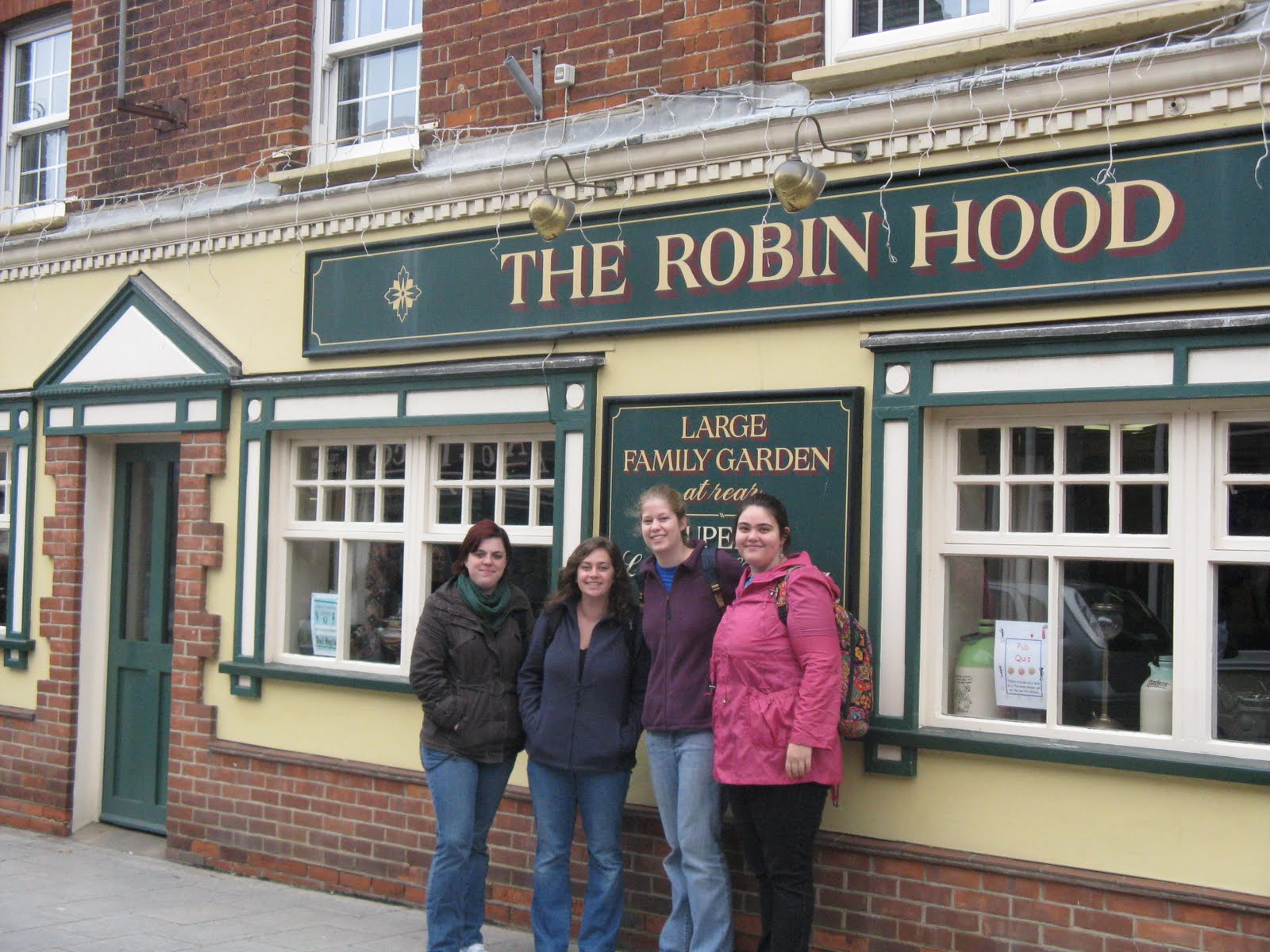
But we enjoyed Sheringham, and several of us want to go back to eat at the Robin Hood pub (we think that it's named this because Sheringham = Sherwood + Nottingham. Yes, this is what we think about sometimes).
So we commenced our hike at the coast in Sheringham and walked through some beautiful countryside. I'm pretty sure that we passed throug Elf counry, and I found where I want to live someday (hint: little stone house with ivy crawling on it). We ended our country jaunt in Cromer, another coastal town, where I spent the afternoon exploring a used book store and dipped my hand into the North Sea. While eating ice cream. Not the best plan that I've ever had! It was a really great day, though.
This past weekend's destination was Ely, a small town in Cambridgeshire (I think). It's name literally means Island of the Eels, and before the Fens were drained it was an island in the wetlands, with lots of eels. They were used as currency for a time! Ely has a gorgeous Norman cathedral, as well as Oliver Cromwell's home, and it's a quintessential British town.
We were lucky enough to catch the apple festival while we were there, so we got to eat delicious apple goods on the town green in the shadow of the cathedral. There was hot cider, homemade apple turnovers, apple and pork burgers, homemade honey and applesauce, pies, everything apple you could imagine or want, plus flowers, crafts, and other festival-type things. Including a Renaissance band! Everytime there was music, I looked and saw a group of adorable elderly folk dancing and playing various instruments! It was the kind of day that I wish that I could have packaged up and sent home to share with everyone there, because it was so wonderful. There isn't really a way to describe it (also, I think that reading Wordsworth and Tennyson is getting to me.) But the real reason we were there: the Oliver Cromwell homestead was a bit silly, but the cathedral was beautiful.
It was founded as a monastery in 673 by the Saxon princess St. Etheldreda, but the current building was constructed in the 1080s as part of the Norman castle-cathedral building craze. It's gorgeous inside, and apparently it's one of the country's best examples of Norman architecture. My favorite part was the Prior's Door, which has maintained its original Norman carvings from 1135. Can we discuss how amazingly old this is?

After engaging in much apple-y deliciousness, we set out for Wicken Fen. I mentioned the Fens last time, but now I've a much better idea of what they are! Basically, they were marshlands and peatfields that stretched more or less throughout the whole of East Anglia. Peat was used for building and for heating, but after it started to run out the Fens were drained for agricultural purposes about three hundred years ago. Now they're full of reeds and sedge, which is harvested and used for thatch roofs. The wind blowing through all of the sedge sounds like the soundtrack to a horror film, so Sarah and I decided that it must be where Harry and Ginny were chased by Deatheaters behind the Burrow in the sixth Harry Potter movie. This obviously means that we were close to the Burrow, which was probably enchanted to look like a windmill. Yeah. We were able to climb up into an eighteenth-century sentry tower to get a view over Wicken Fen, which was beautiful.
I overuse that word, as well, but I don't use it insincerely.

I came to this country determined to find everything beautiful - I wanted that romantic, Masterpiece Theatre image of England. Little villages, rolling hills and fields, the whole nine yards. And I've gotten that, to some extent, but I've also learned to look beyond that. Because the truth is that that particular England doesn't really exist anymore. The villages are still there, and there are apple festivals with Renaissance bands playing by medieval churches, but the churches aren't used nearly as much anymore, and the little Tudor storefronts open to mobile phone stores and boutique shops rather than butchers, bakers, and candlestick makers. There has been at least one Starbucks everywhere that I've gone (except Stonehenge). England has changed - it has to, since it's a cosmpolitan, modern country. What I do like is that the romantic view that I was searching for can still be found - it can coexist with motorways and even with Starbucks. I think that this is possible because the Brits are clever enough to realize that this is what tourists want to see, but also because they really value their heritage, as well. Preserving historical sites is very important here, and I for one am glad.
So even though London wasn't what I expected, for instance, I am still managing to have the time of my life. I worked so hard to get here, and I am going to enjoy myself come hell or high water (this being the more likely of the two, as it rains all of the time). This means that I'm going to try to do as much as possible, and I am going to accept whatever comes my way and make the best of it. Since coming to England, I've changed, not just my view of the country. I've learned to be more patient with people and that a little bit of reaching out goes a long way. And I've also learned to always look on the bright side of life (or at least ninety percent of the time) and to have fun in unexpected places.
I came across a quote from E.M. Forster while reading Howard's End that I really liked: "Life is indeed dangerous, but not in the way morality would have us believe. It is indeed unmanageable, but the essence of it is not a battle. It is unmanageable because it is a romance, and its essence is romantic beauty."
I'm done being soul-searching now, and I won't try to give you any more history during this blog, I promise! (I switched from my introverted, thinking music to Journey, just to make sure.) To make up for it, here are some excellent British insults that I've picked up:
Chav – stands for “council-house associated vermin,” and describes someone whom we in the States would call trashy. Basically the cast of Jersey Shore. In Britain this means someone, usually a girl apparently, of the lower class, who wears track suits in public (a huge fashion faux pax over here), fake designer brands especially of the Ugg or Burberry variety, and bling, and who talks in “common” language, which means that they’re loud and say “like” a lot. (Don't worry, there's a separate stereotype for Americans who do this.)
Wanker – This is probably my favourite word, just because it’s fun to say. A wanker is an inconsiderate, sexist, really egotistical boy. A lot of football (soccer) players are considered wankers here. You can also use wank an adjective, as in, "That guy was totally wank." So go try those on your friends (or not-friends, which would make more sense...).

Friday, October 8, 2010

The Chronicles of Norwich: Freshers Week(s)

Contrary to what it may seem, I was not eaten by a mad sheep upon arrival in Norwich, I just haven't been updating my blog. But now it's Friday night and I've gone and caught a sniffle (Indiana Jones reference? anyone?), so instead of going out to the pub (because there is one on campus), my flatmate and I are getting ready for a night with ice cream and Pride and Prejudice. Fun fact: the British version of the movie doesn't end with the cheesy, un-Austen-like "Mrs. Darcy, Mrs. Darcy" business, because the test audience here thought that it was ridiculous. But you probably don't really care about that.
So yes, Norwich is excellent. I was honestly just so excited to leave London that any change would have been nice, but Norwich is absolutely adorable. We're talking cobblestone streets, winding backroads with corner pubs, a meandering river with arched bridges, Tudor-style buildings, and did I mention the castle in the middle of the city? (Really. It's just a giant stone cube as far as I can tell right now, but we're touring it later), green fields everywhere, sheep in said fields... It's everything that I hoped that England would be. I don't know nearly as much about Norwich as I do about London, so don't worry, but I can give you a really broad overview: before the Industrial Revolution, Norwich was one of the four largest cities in England. It was a very important center for the medieval wool trade, both because there were a lot of sheep here and because of its proximity to Amsterdam. Norwich is in Norfolk, which is in the eastern part of the country, and it was/is mostly wetlands. The wetlands were drained some years ago and became very rich agricultural ground, called the Fens. I'll be learning much more about this later - be excited. Today, apparently, Norfolk is kind of like West Virginia to the English. It's not so far north as to be considered completely redneck, but national lore says that people here are all inbred and so have webbed feet. I haven't seen any of this, but then again everyone has been wearing shoes. I've been waiting for a nice day to go into the city to take pictures, but there hasn't really been one of those yet. It rains all of the time! And supposedly this is the driest county in England. Awesome.
The University of East Anglia is built on the outskirts of town, so we have to take a bus to get into Norwich. The school (and you can't call it a college, because that means something different here. Teenagers have the option of going to a "college" during their last two years of high school in order to better prepare for their A-level exams. A-levels, as far as I understand them, are kind of like NEWTS. You have to have certain grades on your A-levels in order to be accepted to study that subject at a university. Once you pick your subject, you stay with it forever becuase your entire time at university is based on that subject. No such thing as a liberal arts education over here. My flatmate wanted to do literature, for instance, but her best A-level grades were in psychology, so that's what she's doing. I think that it sounds awful.) was built around the 1960s, so the buildings are all actually really ugly. I mean, really, really ugly. Absolutely nothing like quaint, medieval Oxford. Thankfully, the land is beautiful. There's a river right behind my dorm with more weeping willows than I ever imagined in one place, and sheep and horses grazing just on the other side. I've been going for lots of runs by said river and by the lake near the academic buildings, which is good, because I've also been eating lots of chocolate. Cadbury's is so much better over here!
Anyway, I live in University Village, which is the freshers living area on the outskirts of campus. We live in flats - I think that there are 26 in my building. My flat has six people in it, but for the first few days it was just international students. So basically, it was Dickinson people and a few Australians. And the crazy Italian kid in the flat across from mine. Can't forget him. We each have our own rooms with a teeny, tiny bathroom attached. The shower is literally 2 feet by 2 feet, and it's just a drain in the floor. They're affectionately known as "shoilets" because you could in fact use the toilet, wash your hair, and brush your teeth at the same time. So yes, it's tiny, but it's really nice to have my own space again. The one downside is that my window faces the courtyard, so I can hear all of the drunken conversations that happen below my window. Last night there were several Dickinsonians gossiping about other Dickinsonians,and one night I was woken up at three o'clock in the morning by someone playing guitar and singing "Little Lion Man" at obscene volumes. I was so confused that I thought it was Kyle, and had literally thrown on my coat and run half way down the hall before I realized that it was three a.m. in England and it would be a physical impossibility for him to be outside.
I really enjoyed having our first few days here without the freshers, because it allowed all of us international students to get to know each other a little bit first. I have an Australian flatmate, Laura, who is the coolest person ever. She spent the last three months traveling everywhere that you could imagine in Europe. So jealous. We would all head to the pub on campus at night, where they had international trivia, karaoke nights, and other fun/cheesy icebreakers. It was all very low pressure, and I met some really awesome people.
It was a bit overwhelming at first when our British flatmates moved in, but we've been having a really good time since then. We all get along really well, and it's been fun. We've been sharing various cultural elements (my great contribution has been A Very Potter Musical. Yay, America!) and trying out different accents and foods. I made Amy and Becca American pancakes one night, and I think that they fell in love. They've promised me an English breakfast in return. I've also gotten close to some Dickinson people whom I didn't know as well before, so it's been really great. I feel like I'm overusing that word. Too bad, 'tis the truth! The only downside of living with freshers is that they have almost no work to do--their first year at uni doesn't count toward their GPAs. Why? I don't know. But they only go to uni for three years, and all that they have to do their first year is pass, which, by the way, is a 40 percent. This seems incredibly silly to me, because they have absolutely no incentive to do work. So I'm over here writing a 12-page paper comparing commercial theatre in London and New York, and reading tomes of Romantic poetry for class, and my flatmates are going out every single night. Grrr. Ah well.
So the past two weeks have really involved getting back into the business of living, figuring out how to budget my own food (SO SICK of chicken. Oh my gosh. I got frozen shrimp today--big step), going to class and getting back into academic mode, meeting people, and joining societies, and all of that good stuff. I've joined the crew team on a whim, so I'll let you know how that turns out! Professor Qualls had all of us over for dinner our first night here, so we got to meet his family and have delicious food. After dinner, there was a miniature flea market to help us set up our flats--we each got to choose bedding, and then there was a lottery system to get cooking utinsels, lamps, and whatever else people have left over the years. I think it was great that he did that, although Jess, David, and I got some really weird looks walking back to campus hoisting comforters under our arms (or, for David, Superman style) and weilding frying pans. I got similar looks the first time that I spoke in my Condition of England Novel class (great class)--my instructor was apparently so stunned by my American accent that he literally stared at me for thirty seconds and then just moved on. Good start! But my flatmate assures me that people here think American accents are sexy, so I'll take his word for it (note: I don't think that this is why my lecturer was staring). I love this country!
Professor Qualls also took us to a football game in Norwich, which was hysterical. Norwich's club is nicknamed the Canaries, sure to strike fear into the hearts of all, but we beat Leicester City 4-3. It was actually a really good game, and I loved listening to the fans. I couldn't understand a thing that they were screaming, but one was to the tune of "Always Look on the Bright Side of Life." Oh, football hooligans.
I've also been to my first nightclub, which was...an adventure. I couldn't hear for the entire next day, but it was fun. My entire floor went and danced all night long, and I had a really good time. Apparently, the club that we went to is full of "chavs," however. I'm still unclear as to what a chav is, but I think that it's a guy who thinks that he's really cool but isn't. So basically a middle school boy, or a lot of frat bros. Regardless, I enjoyed myself, but I'm pretty sure that this is the reason that I'm sick now. Ah well.
My goals for Norwich have been a) to stay upbeat and positive, and not to worry about the little things, b) to try as many new things as I possibly can, and 3)to get better at meeting people and being more social, and so far all things seem to be going well! I've just been trying to take advantage of things as they come, whether I wanted them to or not, because I have literally been working for years for this opportunity. For instance, Laura, Amy (another flatmate), Jesse, and I booked tickets to Dublin spontaneously because Ryanair was offering roundtrip flights for fourteen pounds. Does it get better than this? I don't think so.
Tomorrow we're going on a hike along the Norfolk coast with the Dickinson group. I'm so excited, so hopefully I'll be feeling better. We're going to see the beach where the end of Shakespeare in Love was filmed, and, more importantly, I get to hike along the British coast! Phase one of Frolicking Through the English Countryside is a go. So yes, I'm having an absolutely amazing time, but I miss all of you and think of you often! Much love!

Friday, September 24, 2010

That's a Wrap on London

So, the last week in London. It was an odd mix of scholarly (or semi-scholarly) activity and touristy fun. We all presented our walking tours during the week, so I spent a great deal of time in the British Library. The British Library is amazing and wonderful, but it's also incredibly frustrating because you can't talk and because the people who work there don't give you any hints as to proper book-requesting ettiquette. You have to request your books online two days before you want to use them, and then you go to the appropriate circulation desk to pick them up before bringing them back to your silent little cubicle. But they don't tell you that you have to do all of these other silly things first, and then they judge you when you make mistakes because no one told you what to do. Grr. But I digress.
So as you might imagine, I spent all day on Wednesday researching the early 1960s in Britain. Not too exciting, but we went out for a Writing Center reunion at a pub called The Court later that night. It was a really good time, and the atmosphere at The Court is great. There are a lot of young people and loud American music, so it's a fun place to go out with a group and just have a good time. Plus, they play "Don't Stop Believing" as their closing song every night, and it was so loud that I got to sing without anyone complaining. That was especially nice, because it was one of the first nights that I didn't have to do homework, and I felt as though I was finally able to enjoy a little bit of London like a twenty year-old is supposed to do.
Thursday was another day of work--we walked our tour route again (without asking directions to any fantastic places this time) and hammered out a lot of the speaking parts. We were good humanities students and drew overarching connections and themes between history and music... look at us go! After our walk, I snuck away to a discount bookstore on Charring Cross Road (Kaitlin assures me that the Leaky Cauldron is supposed to be on Charring Cross Road, but I cannot confirm this. The bookstore looked like it belonged in Diagon Alley--stacks of books on every available surface, not a lot of rhyme or reason--it was heaven). This store has books for $1.95 (except in pounds)!!!! I was happy.
Friday was a bit more exciting, I promise. Well, I went to the British Library again in the morning, but I couldn't focus and so left to go see about half-price theatre tickets in Piccadilly Circus after lunch. The man in the booth was completely unhelpful and kept spitting sandwich crumbs at me, but I met two very nice Lithuanian women. We bonded over having bits of cheese sprayed at us. After popping into the Wellcome Collection to see an exhibit on skin (weird), I headed to the National Theatre to meet the rest of the group for a backstage tour. The National Theatre is cool because it's a pretty innovative venue, and it's a charity, so all proceeds go directly back into the theatre. Their mission is to provide exciting, new theatre (and some of the classics) to audiences at reasonable prices, and they make all of their sets and costumes on location. During the summer they have free outdoor events centered on a set of giant, turf-covered furniture, so we were acting like three year-olds. After the tour we stayed to see The Habit of Art, which was a play within a play type deal. Good, but not my favorite. BUT--sitting appoximately seven seats away from me was... SIR IAN MCKELLAN. I know, whoa. I did not talk to him, though, because one does not bother a wizard. The actors got wind of this by the second act, and since the play took place in Oxford they inserted some new dialogue: "Professor Tolkien was at dinner. Apparently he's writing another book."
"Wonderful. Probably more fucking elves."
Saturday was a great day. We rehearsed our tour again in the morning, and it went really well. Our group got along well and I had fun workiing with [most] everyone. Stephenie and I met Jess and Kaitlin at Old Spitalfields Market for lunch, where we got crepes and wandered into a huge Japanese festival. Lots and lots of Japanese food, traditional clothing, and cultural demonstrations including drumming and martial arts. We also got to walk through some medieval ruins because it was Open House Day, which is when all of these historic places in London are open to the public.
Stephenie, Sarah, and I decided to go to King's Cross to look for Platform 9 3/4 after escaping from the crush of humanity at the festival, and we were finally successful! It's actually at 8 3/4, which I guess doesn't sound as cool as 9 3/4. I pushed really hard, but alas, I could not get through the barrier. We did miss the September 1 deadline, though, so that's my excuse.
Saturday night I took a solo trip to see War Horse, since Jessica hated it so much. This logic actually worked--I loved it! The show is about a young boy and his horse in Britain at the outbreak of the First World War. His horse is sold to an officer, so the boy up and enlists, and is sent to the front, but never stops looking for his horse. Sounds kind of weird, but I actually got really invested in the story, and the staging was absolutely incredible. It was a little like Lion King because the horses are puppets, and you can see the puppeteers working the mechanisms, but they were so believable! I really, really enjoyed it.
On Sunday morning we actually gave our walking tour, which went really well. So yeah, if you want to know anything about why the 1960s rock music scene was possible in London, just let me know! We had to be the audience for a tour that afternoon in Westminster, so Stephenie and I headed that way for lunch. We just so happened to stumble across a celebration at Westminster Abbey--it was the seventieth anniversary of the Battle of Britain (when the Nazis tried to bomb the daylights out of London in order to crush British morale, enabling them to take the country. The Royal Air Force put up a hell of a defense, otherwise we'd be speaking German right now. Winston Churchill commemorated the occasion when he said, "Never have so many owed so much to so few."). Most of the Royal Family was at the Abbey, and tourists were just lining the road. There was a procession with a military band and a division of the RAF (I assume) and a flyover by a Hurricane and a Spitfire, two planes that were important to Britain's defense. There you go, Dad, just for you. Apparently several RAF veterans had done a flyover earlier in the day, and it was the first time that they'd flown in formation since the war. It was very cool, and it was interesting to see how a country that was on the front line (more or less) of the war commemorates it. Also, we were walking in St. James Park afterward and Prince Charles, Camilla, and Prince William drove by. I'm just saying, London is cool.
We wound up in Covent Garden after the second tour--such a cool place! It's a giant, semi-permanent market that sells all of the scarves that you could ever want, basically. Also, delicious cookies. So I browsed, ate cookies, and watched the street performers (they were everywhere). Street performers here are very mean to their audiences! It was a fun way to spend the afternoon, and then I headed to Chinatown with Steph for dinner. Chinatown here is part of SoHo, and it's basically just restaurants, and a few corner grocery stores. But it's really colorful and fun. We met some other friends and proceeded to eat too much food and laugh much too loudly. It was excellent!
Monday was an entirely free day, which was absolutely amazing. Kaitlin and I headed to Buckingham Palace in the morning to watch the Changing of the Guard (told you that I was doing all of the touristy stuff this week). Let me explain my feelings regarding the Changing of the Guard: it's the most ridiculous thing that I've ever seen! All this pomp and circumstance and stopping traffic for something that could be discreet and take all of five minutes. But no, tradition must be followed! I mean, yes, it was fun to watch the guards march in and out, but after 45 minutes it was a bit old.
Anyway, there are the guys in funny hats. Enjoy. Following this spectacle I actually went into Buckingham Palace and toured the State Rooms, which are open during the summer while the Queen is at Hollyrood in Scotland (except she was at Buckingham while I was there. Shh.). The rooms are absolutely gorgeous. I forget how old the original estate at Buckingham is, but it was the home of a duke for a bit until George IV made it his palace. John Nash designed it and went incredibly over budget, and so it wasn't finished until Queen Victoria's reign. It's stunning, as you might expect, but there are SO MANY TOURISTS. Most of them from Asia. I still have not found a suitable explanation for this phenomenon. After a month in London, I was quite impatient with "regular" tourists, even though I was technically still a tourist.
I spent the afternoon at Regent's Park, in Queen Mary's Garden amongst all of the roses. It was quite lovely--parks in London are fantastic. I think that there are so many parks because Londoners recognize their own need to escape from the city. In the parks and gardens (and even the little neighborhood squares) you can almost forget that you're in the most cosmopolitan city in the world, and you can escape from the noise, the dirt, the tourists, and the sense of a crowded rush of humanity bearing down on you. That's why Hyde Park and Kensington Gardens were built--Queen Victoria realized that Londoners needed a break from all of the pollution and grime in the newly industrialized city, hence, a ginormous park.
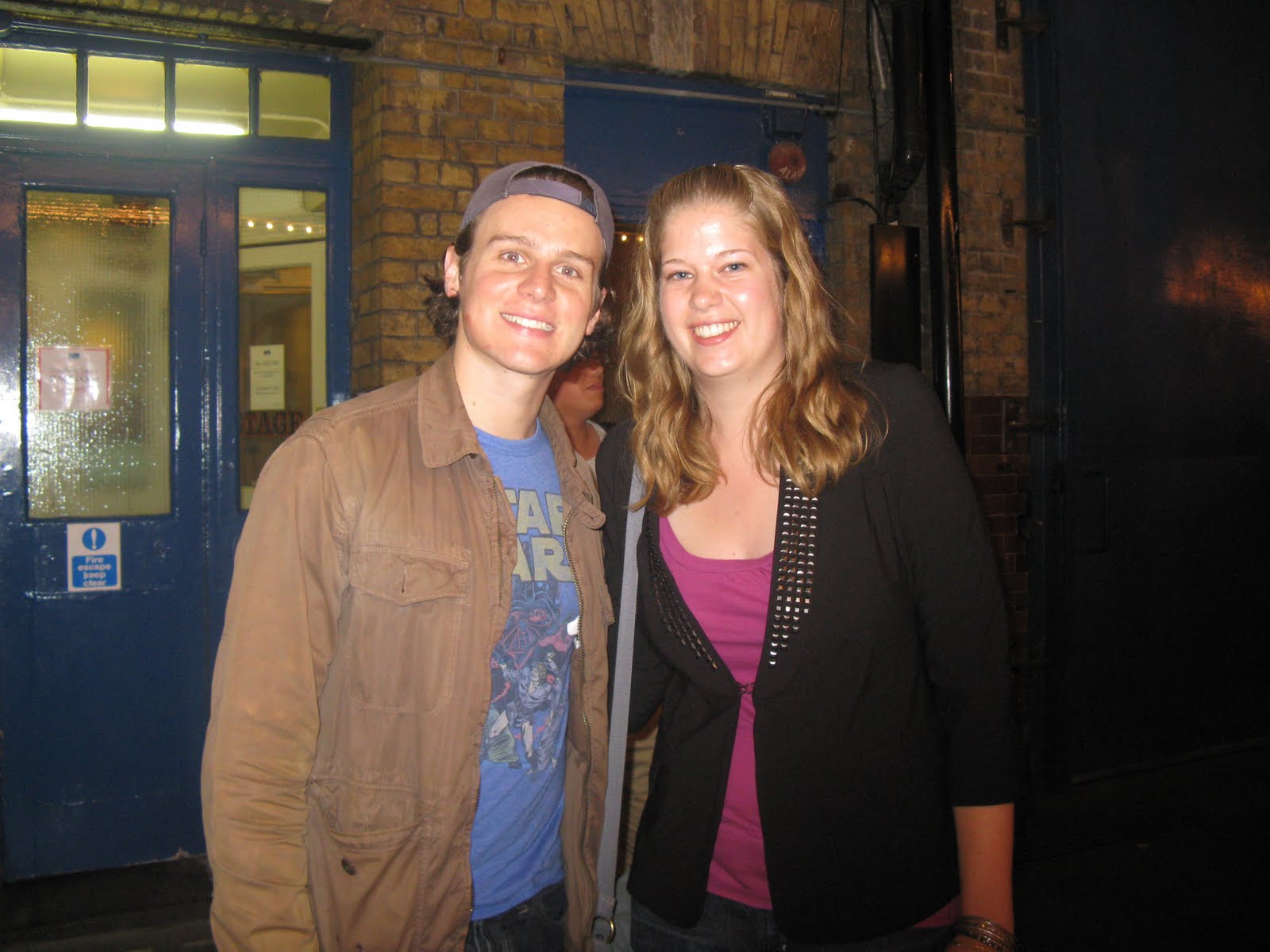
Okay, nature rant over. Monday night was also excellent! We went to see Death Trap, a new thriller-comedy (sounds like a good combination, yeah?) that we'd been seeing ads for all month. We got half-price front row tickets! I love the theatre in this country. It wasn't my absolute favorite show, but it was really good and really self-aware. All of the shows that I saw in London (except maybe Les Mis) were very aware of the theatrical traditions that they were coming from, and they played with those conventions. So maybe the British focus on tradition is good for theatre, but bad for traffic at 11.30 in the morning by Buckingham Palace. Anyway, we got to meet Jonathan Groff (Jesse on Glee) after the show (he was one of the leads). He was really nice and didn't seem to mind that there was a group of American girls waiting for him at stage door.
Tuesday was our last day in London, which was so weird. We'd all grown so used to being in the city that it became normal, so leaving for another new place so soon made all of us a little wary. So I was nervous, but excited because I was ready to leave the city. I also had trouble remembering that I wasn't heading home after London--I was going elsewhere for much longer than a month! But we had our last class gathering on Tuesday morning. We hiked up to Hampstead Heath, which offers a beautiful view of London (beautiful view, ugly city. What can you do?) So there was some sentimental wrapping up from some, and frolicking from others. I was one of the frolickers, and we got very lost on the heath (which is just a name for a big hill) on our way back to the city. I considered writing a gothic novel while I was there, but we found our way out again.
That night my friends actually convinced me to go on the London Eye. Yes, me, with my fear of ferris wheels, rode the largest ferris wheel in the world, white-knuckled all of the way. It was a half-hour ride, and it really was beautiful. London at night is amazing. Much nicer than London during the day! We had a great time though, and some of the cliquier members of the group actually condescended to join us. Dinner at a pub afterward, and I felt like it was an appropriate way to say goodbye to London.
So I definitely enjoyed my time in London--I was able to do some absolutely amazing things and I learned a lot, both about London and about myself. It was a fantastic experience, but I am glad to be out of the city. Norwich has been absolutely amazing so far, and I'll try to update on that soon!

Tuesday, September 14, 2010

"Excuse me, officer, could you tell us how to get to Mordor?"

What's this? Could it be another update so soon? Indeed! Basically, I'm procrastinating on writing intellectual blogs for class, so you all get to reap the benefits (assuming reading about my various adventures is a benefit).
We got to be tourists again on Friday, when John, our wonderful blue badge guide (the official England guides, sort of like cabbies--fountains of random knowledge) gave us a tour of St. Paul's Cathedral. Some of the random knowledge that I picked up--a cathedral houses the seat of a bishop, whereas a church does not. But St. Paul's was beautiful. There's been a church on that spot for hundreds of years, but it's kind of like the Swamp Castle in Monty Python and the Holy Grail--one was built, then it burned down. A second one was built, and that burned down. A third church was built, and that got pretty delapidated because it took up so much space that people started using it as a thoroughfare to get from one side of the city to the other, so there would literally be horses trotting on through. Finally someone with sense commissioned Sir Christopher Wren to renovate this church. He said something along the lines of, "Well, this building sucks, let's build an entirely new cathedral!" to which the The Powers That Control Finances replied, "Um... no." But then, presto! The Great Fire happened in 1666 and burned that church down, too, so Wren got to start all over. It took him some thirty years to build, but it's gorgeous. One of the only surviving parts of the pre-1666 church is John Donne's statue. Donne was a famous poet in the seventeenth century, and also served as dean of St. Paul's. He coined the phrase, "No man is an island," to which John our tour guide responded, "Except the Isle of Man."
We didn't get to take photographs inside of the cathedral, but a group of us climbed to the top of the dome. Until the building boom following the Blitz, this was the highest point in London at 365 feet, and it took over 500 steps to get there. The first area that you come to is inside of the church still, and it's called the Whispering Dome. You can stand on one side, whisper something into the wall, and a person standing on the opposite side will hear it. Up another, much narrower staircase was the Stone Gallery, which is on the bottom of the outside dome. This offered some beautiful views of London, but the view from the very, very top was even better. Climbing up the last third felt a little like a scene from The Hunchback of Notre Dame because there are spiral staircases going everywhere, and it was a little scary. The view was amazing, though, even though London is definitely not the prettiest city in the world. Ah well.
After our morning workout, we headed to a lunchtime concert at St. Martin in the Field. After explaining to Stephenie that this was actually a church, not a field, I enjoyed a very nice program by a woodwind trio from the Guildhall Music School. After this concert, a small group of us ate the best lunch ever at a small Italian cafe. The food was amazing, and they were running a promotion where we got free desserts. Awesome? Yes.
Saturday was another day out of London! I've really enjoyed being in London, but I'm very excited to move to Norwich where life will be a little more relaxed and less crowded. Walking in London is incredibly frustrating because there are no established traffic patterns. You'd think, "Okay, they drive on the left side of the road, so people probably walk on the left side, too." Well, that only applies to about one-third of the population. Another third walks on the right side, and the last third just walks down the middle of the sidewalk and runs over anyone who is in their way. And no one will look at you, either. They just stare straight ahead and book it to wherever they're going. Very odd.
So on Saturday we escaped (kind of) to Oxford in the morning. John came with us and gave us a very nice tour of the college area. The University of Oxford is made up of 39 colleges who are all under the authority of the university. The school has existed since the twelfth century when English scholars returned from France and received a charter from Henry I to establish a college. Now, Oxford is famous in my book mainly for two things: 1) the Great Hall of Hogwarts is almost an exact replica of the dining hall in Christchurch College, and 2) J.R.R. Tolkien taught there. He and several other literary figures, including C.S. Lewis, were part of a literary society, called The Inklings, that met at the Eagle and Child pub. I did not get to go to this pub and make the proper homage, but I did get to see Merton College, where Tolkien taught Anglo-Saxon history. It's not much to look at, but this is where he was grading papers one afternoon and wrote on the back of one, "In a hole in the ground, there lived a Hobbit." So no Harry Potter Great Hall and not much Tolkien, but Oxford was a beautiful example of a medieval town.
After our tour, we piled back on the bus to head to Stratford-upon-Avon, which truly is a tourist trap. But being Shakespeare's birth place and all, it's pretty important. Shakespeare's childhood home is a bit of a joke, and I felt as though I was on Splash Mountain instead of in the home of the man who was arguably the greatest writer in the English language. We were herded into several rooms with scenes painted on the walls and ridiculous animated movies playing, and artifacts would light up at random times. Very, very touristy. But we got some fun pictures. We also visited Shakespeare's grave in Holy Trinity Church, so I felt that the appropriate pilgrimmage was made (his tomb is not nearly as attractive as Leonardo DiCaprio's Romeo though, so you get the picture of Leo instead. Check facebook for more photos!)
Sunday was a completely free day, which was wonderful. It's been difficult finding time to catch up with myself, especially since I'm always around people. Part of this is the nature of the program, and part of it is living in a city. I've realized that I'm fairly Wordsworthian in that I need trees and rolling hills, and quiet. But I got some decent work done in the mrning, and then my group visited all of the sights for our walking tour of 1960s rock music in London. We got to see Abbey Road studios and the famous zebra crossing. This is the only place in London where motorists actually pay attention to pedestrians because it's a zebra crossing and because there are always at least four tourists trying to cross in a line, with a fifth member taking a picture from the middle of the road. And yes, we're going to try to recreate it next time we go back! But it's cool because the walls outside of Abbey Road Studios are painted white, and people have written messages all over them. I could see earlier messages through the paint--I wonder how many layers of paint are on those walls? We got a bit turned around trying to find Wardour Street, so we decided to ask a passing police officer (or bobby, I guess I should say). David misheard me when I said, "Wardour," and so he actually asked the poor guy how to get to Mordor. Quite understandably, the policeman looked at us like we were completely barking.
That night, all of us headed to the South Bank to visit the Thames Festival, which was a lot of fun. There were beautiful lights up everywhere, and a lot of craft and food vendors, plus live music. It was a beautiful night and a really great atmosphere. We ended the night on Millennium Bridge watching fireworks over the Thames. It was fantastic.
Monday was back to work, and we spent the morning at the East London Mosque, which was very, very interesting. We had all read about Islam prior to our visit, but our guide wasn't sure what to do with us. He asked, "So what do you know about Islam?" This is like asking, "Well, what do you know about books?" Where would you like me to start? What would you like me to say? So no one said anything for a second, and I think that he stereotyped us as ignorant Americans. He did take us through the basic beliefs of Muslims and opened the floor to questions, but he seemed very defensive. He was very quick to dismiss fundamentalists and Muslims who mistreat women or participate in violence as false Muslims. He did draw some interesting points about the differences between the Islamic faith and various cultures that Americans view as extremist or backward. Islam is actually a very tolerant faith. Because our guide immediately stereotyped us, however, I think that we missed a chance at a good dialogue. He mentioned the need for cross-cultural understanding on the parts of both Muslims and non-Muslims, but he didn't seem to want to engage us on that level. Even more interesting, when we were out in the lobby we were watching some children playing in a gymnasium area nextdoor. A woman who was obviously from a more conservative Muslim tradition saw us and immediately pulled down the blinds in the windows and locked the doors to the gym. Very interesting. Stupid pastor in Florida.
Lunch was in Old Spitalfields Market, and I tried Indian food for the first time since I've been in London. It was delicious! We had class discussion in the afternoon, and then the alumni event that I alluded to earlier was that night. We got all dolled up and went to Barclay's to hobnob with President Durden, the chairs of the Board of Trustees, and other alumni. It was probably the highest society that I've ever been in.
President Durden asked a really interesting question, as only he would: have we seen anything since being in London that has changed our ideas of what we want in life? This definitely got me thinking. My political views have certainly become more formed through a combination of listening to NPR all summer and through seeing the British government system and how it works, but I will not bore you with that here. Another aspect of London that I have fallen in love with is the incredibly easy access to the arts here. Londoners seem to have a keen interest in good art and in making that accessible to people. Most of the museums are free (maps are not, however, which is where they get you!) because they're subsidized by the government, and some of the most famous pieces in the world are here. And I've gone to the theatre so many times, for only a small fraction of the price that I would have paid in the States. There's also a global awareness here, both in the arts and in other aspects of life, that I really love, especially since it's mixed with so much history. I don't know if I could live in London, but I do love those aspects of the city.
Today we visited a synagogue in the morning and learned about the history of the Jews in Britain. I've really enjoyed learning about so many different religions during our time here. This afternoon we saw a play called The 39 Steps, which is a spoof of the text that inspired the Hitchcock movie of the same title. Again, loving the theatre--it was fantastic. It was so clever and spoofed not only Hitchcock but theatre and Englishness in general. It was so well done, and the performers' timing was impeccable. Apparently it's playing off Broadway now in New York, but I don't think that it will do very well in the States. It's just so wonderfully British, and I think that a lot of the humour would be lost on the general public elsewhere. I realized half way through the show that I actually watched a Masterpiece Theatre adaptation of the text last year, so I enjoyed it even more. It was like Spamalot, except it made more sense.
Well, that got rather long-winded there, but now you're all caught up! And this week will be a lot of research, so not as much to report back. I miss you all, and I think about you a lot, especially when I have to get up and I remember that I could be sleeping for five more hours in the States. One more week in London!

Monday, September 13, 2010

Off With Her Head!

So I've been horribly remiss about keeping up with the blog in the past week--apologies! I've been very busy running around to different places and hobnobbing with alumni. This past week was our last week of major class outings and discussions. We've started working on our final projects, which involve creating a walking tour for a specific community in London. As an homage to Pirate Radio, my group is concentrating on the advent of rock music in the 1960s and what it meant for youth culture in London.
So I left off on last Saturday, yeah? (that's how everyone talks here--you either have to add "yeah?" or "innit?" on the end of fairly rhetorical statements.) Sunday was the first time that I was able to sneak off alone, and it was lovely! We had the whole day to ourselves, so I took a solo trip to the National Gallery in the morning. Best decision that I've made since I went to see Billy Elliot. The National Gallery is fantastic--they have a great collection of pieces ranging from Duccio to Van Gogh. I got to see Leonardo da Vinci's cartoon for "Madonna and Child," as well as William Hogarth's "Marriage a la Mode" and several great paintings by Gainsborough, Turner, Monet, Degas, and others. I'm really glad that I took an art history class!
Stephenie and Matt met me for lunch, and then the three of us headed to Kensington Gardens to conduct more creeper park research. We saw Kensington Palace, where the gates are still covered with notes and pictures of Princess Diana. We also found the Peter Pan statue after much hunting and getting rather turned around. That's another thing off the bucket list (we tried to find Platform 9 3/4 the other day, so we headed to King's Cross and looked for Platforms 9 and 10. First of all, there is no barrier between said platforms, just an open track. Second, it's outside. What??)
Sunday night I had a ticket to see the world premier of Bedlam, the first show written by a female playwright ever performed at the Globe. It takes place in Bedlam during the eighteenth century and is about the corruption of the institution, although it's a comedy... Yeah, it didn't work too well. I enjoyed it, but I won't be rushing back to see it.
I spent most of Monday at the Victoria and Albert Museum, which is the craziest place ever. Holy crap. I have never seen so much stuff packed into one place. And it's all shiny! It was total sensory overload. But seriously, that museum has exhibits on everything from fashion to jewelry to micromosaics, to every piece of silver that has ever been hammered into any shape that at least resembles a dish, to medieval artifacts. The material wealth in that museum is ridiculous, and it drove home the idea of a consumer culture. Imperialism begets opulence and the accumulation of random stuff from every corner of the world. There is so much stuff in there that it's impossible to take it all in--your eyes just start to glaze over. My favorite part was the exhibition of Beatrix Potter's original illustrations to Peter Rabbit.
After escaping from the V&A (the maps were completely useless, so you actually did have to escape), a group of us went to see Les Miserables at the Queen's Theatre. Stephenie had dragged us all over creation in the morning in order to get tickets, and I'm glad to report that it was worth it (and I only paid 20 pounds. Win). The show was beautiful, full of big, belty, Broadway classics that are still stuck in my head... very enjoyable. I did like Billy Elliot better, though, because I thought that it was more honest. But I mean, Les Mis is Les Mis, and it's hard to argue with that. Now I want to read the book!
On Tuesday we visited the gorgeous Shri Swaminarayan Mandir, a very famous Hindu Temple. They had a fantastic educational exhibit, so we learned about the basic Hindu beliefs and even got to take part in a prayer ceremony. Growing up as a Christian, I was always taught that the worship of idols is bad, but the Hindus believe that their idols are actually imbued with the spirits of the gods they represent. They dress the idols everyday, leave them food three times a day, and even put them down for afternoon naps. It was really interesting to see, and I learned a lot. Everyone there was so welcoming, too, and they were amazingly tolerant of other beliefs.
Wednesday was the two-week mark, which seems insane. I feel like I've been in London forever. I'm pretty sure that there's a time warp thing going on somewhere over the Atlantic Ocean. Time-space continuum aside, I visited the Sir John Soane Museum on Wednesday morning. Another fun fact about imperial nations--if you're rich, you can buy important artifacts from all over the world, stick them in your house, and then open it as a museum! Material culture again, I'm telling you. But Soane was an important architect in the Victorian Era, and he actually designed his home to hold all of these insane artifacts. I mean, the man has Hogarth paintings tucked in a little room, and there are Turner sketches on the secret walls that fold out from the main walls. He also built a crypt to house his Ancient Egyptian sarcophogus. Right then. The whole place reminded me of a wizard's house--it looks completely normal from the street, but you walk in and BAM! there's a giant wave of eccentricy streaming from every room. He had a Shakespeare shrine built into his wall. Win.
Thursday was yet another long day, but it was excellent. We visited the Tower of London, and I spent all morning there. It's extremely touristy, but it's also an incredible place in terms of British history. We saw the Crown Jewels first (can't take pictures of them, though), where the guards talked to me and Liz for almost an hour. The magnificence of the various crowns is incredible. One of the kings once complained that he was tired of wearing the heavy crown (they're about five pounds)--Sir, you have over 2,000 diamonds on your head, which is more money than I will probably ever make in my life. Shut up.
Liz and I spent the rest of the day investigating the Bloody Tower, where the Princes in the Tower were supposedly murdered (NOT by Richard III, thank you Shakespeare), Tower Green, where Anne Boleyn was executed, and other fun, nerdy-awesome sights. The Bloody Tower is only named such because it's where the Princes were murdered (the picture shows the staircase in the White Tower where their skeletons were found), and Beauchamp Tower is where many political prisoners were kept, including Elizabeth I, Anne Boleyn, Robert Dudley, and Lady Jane Grey. The White Tower (not in Gondor) had a lot of fun exhibits, including armor from King Henry VIII. In Tudor times, the White Tower housed the armory, the Line of Kings exhibit, the chapel, the garrisons, and served many other important functions. Fun fact about the Tower of London: the royal ravens are also kept here. Legend says that when the ravens leave the Tower, the monarchy will fall. So what has the monarchy done? Clipped the ravens' wings. True story. Cheating? Yes.
Thursday afternoon was spent at the British Library, which is mammoth. A lot of things here are mammoth--maybe the Brits feel that they have to keep reminding the world that, once upon a time, they had the biggest and the best of everything. But the Library is like a city unto itself, complete with eighteen thousand cafes and, of course, a gift shop. But I got my reader card and went through the "Treasures of the British Library" exhibit. This was absolutely amazing. They have the only surviving manuscript of Beowulf, arguably the mother-text of all subsequent English literature. Oh my gosh. I cried a little bit, not going to lie. In the same case was a gorgeous illuminated copy of Sir Gawain and the Green Knight, and further down the line was Jane Austen's journal and writing desk! Too much literature wonderfulness to handle! Other treasures included a typed and edited poem by Oscar Wilde, Shakespeare folios, hand-written Beatles lyrics, and a draft of a Wordsworth poem. Oh, and the Magna Carta. No biggie.
That gets us through most of the days, yeah? I'll catch up more later, but now I have to go to bed! Love and miss you all!

Saturday, September 4, 2010

"What are men compared to rocks and mountains?"

The immortal words of Jane Austen...especially relevant this week as we got to explore outside of London (not that London isn't amazing, of course). But that will have to wait until Thursday. Wednesday was much more business as usual. We started off with a walk through the East End. The West End is famous for its theatres and for being the playground of the wealthy, but the East End has always had a bad rap in London's history. It started as the area outside of Roman Londinium, so it's always been separate and sort of mysterious. Later on it became an industrial center, full of slums, with overwhelming poverty and violence. Pick up a Charles Dickens novel--you'll see. In the Victorian era it was home to Jack the Ripper, who both made it famous and further degraded its reputation. The East End was also Cockney territory ("'ello, guv'nah," rhyming slang, and all of that), but it's been home to immigrant communities for hundreds of years. The Huguenots moved to the East End from France in the eighteenth century to become weavers, and a sizable Jewish population grew there during the Russian pogroms of the nineteenth century. In the past twenty or thirty years, however, these groups have moved farther out of the city and the Bengali population has exploded. The area around Brick Lane is called Banglatown because of the enormous concentration of Bengali immigrants who live there. The community has remained very close, with a tight center on religious and family values. Now, however, young "yuppies" are starting to move into old warehouses that have been turned into apartments, which drives up real estate costs and forces poor immigrant families out of the area. There you go, more than you ever wanted to know about the East End.
We had a class discussion (imagine that) after a quick lunch at a nearby pub, and then we had an awkward amount of free time. Professor Qualls doesn't really seem to have a realistic idea of how long it takes to eat lunch or how long it takes to go anywhere productive in the city. We wanted to go to the Tate Modern, but there wasn't time before we had to be at St. Pauls, so we got distracted by the Olde Sweet Shoppe instead. Good decision.
At 5 we attended Evensong at St. Paul's cathedral, and I got to sit in the choir stalls (called the quire, no idea why). The singing was beautiful, although everything involved so much pomp and circumstance. Following prayers, some of my friends and I hit up a grocery store to buy ingredients for dinner. Our favorite grocery store is called Sainsbury's, which is middle of the road. I've noticed that grocery stores are much smaller here than they are at home, I think because people tend to buy more fresh food here and therefore go to the store more often. For example, the only frozen vegetables available in London seem to be peas. I don't know why peas have been given this honor, but there you go. Anyway, I made avegolemono soup, and we had bread and grilled peppers. We had to fight the other group for the kitchen, which was a fairly political battle, but in the end everything worked out, and I got to have my favorite soup. After clean up we had dessert and cider in the garden, which turned into the hotel staff (who were having a fairly rowdy gathering already) giving us free bottles of wine, which led to drinking wine with Professor Qualls and Carol Anne in the kitchen until the wee hours of the morning. Good times. Tired times, but good.
Thursday, of course, was our earliest morning thusfar. We got on a coach for the two-hour ride to Stonehenge, which I was very excited about. I wasn't disappointed. Even though the walking path is literally ten feet from the highway (and by highway the Brits mean a narrow two-lane road through the countryside) and there were a gigabazillion tourists there, everything around the henge was still tranquil. I knew that Stonehenge was an engineering masterpiece, but I didn't know how sophisticated it actually is. First of all, the inner circle of stones was built around 3500 B.C., and the outer stones were added a few hundred years later, around 1600 B.C. Wow. Second, about one-third of each of the standing stones is actually buried underground. Third, the sun rises through a different space every month of the year--Stonehenge is a calendar. So incredible. I've come to the conclusion that the only rational explanation is magic.
After our brief time at Stonehenge, we piled back onto the bus and drove through the Salisbury Plains. I wanted to see the chalk horses in the side of the hills, but our road didn't take us that way. Before too long, though, we were descending into the city of Bath, which is absolutely beautiful. It looks like an old European city, with cobblestone streets and beautiful Georgian architecture in warm stone. So, so pretty. And it's legendary Jane Austen country (she lived there for several years, and although she didn't write very much there, Persuasion and Northanger Abbey both feature parts set in Bath. It was the fashionable place to be). We started off in the Roman Baths, which were built around 60 A.D. Bath is home to the only hotspring in the United Kingdom, and the Romans built the baths and a temple to the goddess of the springs there. It's maintained its popularity as a destination for people to go and take the "healing waters" of the spring.
We wandered through the museum and saw the Roman ruins, then Liz and I found our way to the Pump Room of Jane Austen fame. This was the place for all sociable people to see and be seen during the day in Georgian Bath. It was here that people formed acquaintances so that they could be invited to dinners and parties later. So Liz and I sampled the famous water, which was hot and tasted kind of nasty. Not sure about its healing powers, but I think that once is enough!
After the baths, the rest of the afternoon was ours, so Liz and I almost ran to the Jane Austen Centre, where we spent a lovely afternoon going through the exhibits and the gift shop. We also had proper afternoon tea in the Regency Tea Room run by the Centre.
I had a great time in Bath, and I definitely hope to go back. We didn't have time to see anything beside the Jane Austen Centre (again, Professor Qualls's concept of time is very different from mine), and I would love to see the Crescent, the Abbey, and the Fashion Museum, as well as just exploring the beautiful city. Check out my facebook for more pictures of Bath, because there are a ton!
Since Thursday was also Stephenie's 21st birthday, we caved and went to Hard Rock Cafe with her for dinner and drinks (21 is still exciting, even if it is in England), so it was a really fun end to a great day.
Friday was the Day of Museums. In the morning I visited the National Portrait Gallery and saw surprise! Cassandra Austen's portrait of Jane, along with the first part of the collection. I liked being able to put faces with names of various historical figures (like the entire cast of characters in Elizabeth). But we only had an hour or so there before we had to meet at Westminster Abbey for a guided tour, which was phenomenal. The Abbey is gorgeous, of course, and there are so many famous people buried there! I looked down once and realized that I was walking on David Lloyd George's grave, so I hastily stepped to the side. Probably walked over Charles Darwin. Who knows. Fun fact (or maybe not, you may be sick of these): every English monarch since William the Conquerer in 1066 has been crowned on the sight of Westminster Abbey. It was built in 950 by Benedictine monks, then Edward the Confessor made it a church in 1042. That didn't survive, so Henry III built a more magnificent church that included flying buttresses (I mean, how could you go wrong?) in 1216. Edward I was therefore the first king to be crowned in the actual church.
Lunch was in St. James Park, by Buckingham Palace, where we had to awkardly observe other people and take pictures for a class assignment. After our anthropological stint we visited Winston Churchill's War Rooms, the underground cement bunker where he directed World War II. When Churchill and his cabinet left the bunker in 1945, they literally just up and left all of their papers, pens, etc. on the tables (I guess I would too after being underground for the better part of five years), and those rooms have been preserved just as they were. It was really cool to see, and they have sound clips from meetings and even a phone call between Churchill and President Roosevelt.
Kaitlin and I hurried back to the National Portrait Gallery (by way of Big Ben) after the War Rooms, where we finished going through the collection. You'd think that two and a half museums (I count the Abbey as half a museum) would be enough, but no, we had to go to the British Museum before dinner to see certain artifacts. We're still working with the series "A History of the World in 100 Objects," and last night we saw the Rosetta Stone and a few other objects. The Rosetta Stone makes sense to me, but one of the other objects was a collection of clay cow figurines from Ancient Egypt. Really? Maybe I was just out of patience. The British Museum annoys me, because I feel like it says, "Oh hey, we stole a bunch of random stuff from all of these other cultures because we're the biggest, baddest, most imperial nation ever, and now that we don't have an empire anymore we're just going to stick all of this stuff in cases with little tags." Job done.
Today was less museum-heavy (thank goodness). We started out with another classroom discussion, this time about Virginia Woolf's Mrs. Dalloway. For lunch we went to Borough Market under London Bridge, which is the oldest produce market in London. There were amazing amounts of food there, and it all looked so good! After lunch Professor Qualls led a walking tour of Southwark, which is on the South Bank of the Thames. Basically, the North Bank, where the Square Mile is, decided that everyone who was deemed "unworthy" could live on the South Bank of the Thames, so all of the criminals, prostitutes, dock workers, and *gasp* actors were shipped there. The Elizabethan theatres, including the Globe, were all built on the South Bank, in the red light district no less. The South Bank had become synonymous with entertainment and debauchery, as well as crime, by Shakespeare's day. All of London's major prisons were here, too, including Newgate and The Clink, which was so notorious that it has given its name to all other prisons. Lovely place, really. Now it's been cleaned up, and the late 1990s saw major efforts to develop it in time for the new millennium. This is when the Millennium Bridge, the new Globe Theatre, and the Tate Modern came into being.
Speaking of the Tate Modern, I visited it after our walking tour was done. I have come to the conclusion that modern art and I are just never going to get along. Ever. I came, I saw, I shook my head in confusion, I left. We had a lovely barbeque (although British people haven't seemed to have mastered the art of grilling in the thousands of years of their existence) courtesy of the hotel, and I decided that a quiet evening was in order. More museums tomorrow!
Author's note: If you're bored to tears by my random tangents into British history, let me know. I just find it all so fascinating, and I want to share what I'm learning with you.